
The Hidden Cost of Truck Downtime After a Backing Accident


Most fleet managers can tell you the repair cost of a backing accident off the top of their head. What they usually can't tell you is how much that accident cost in downtime.
That's because downtime doesn't show up on a single invoice. It spreads across your operation in ways that are hard to track but easy to feel: missed routes, overtime for other drivers, idle employees, admin hours spent on paperwork, and customers calling to ask why their service was disrupted.
And for fleets in waste management and construction, where trucks reverse constantly, and schedules are razor-thin, a single out-of-service vehicle can throw the entire operation off for days.
This is the cost nobody budgets for. Let's break it down.
What Does a Day of Downtime Actually Cost?
Every day a truck sits in a repair bay instead of running its route, your fleet is losing money. Industry estimates put that number between $448 and $760 per day per vehicle, covering lost revenue, driver wages during non-productive time, and schedule disruption (Fleet Maintenance / Element Fleet Management). Other estimates go higher, with some industry sources citing $850 to $1,000 per day when you include the full ripple effect across the operation (FleetOwner).

And that's per day, per vehicle. A backing accident that damages a truck badly enough to need body work, frame repair, or part replacements can easily keep that vehicle out of service for one to three weeks. If specialized parts are on backorder (which happens more often than anyone wants to admit), it could be longer.
At $760 per day for 10 business days, that's $7,600 in downtime cost from a single incident. At $1,000 per day for 15 days, it's $15,000. That's before you count the repair bill itself.
The Ripple Effect: It's Not Just One Truck
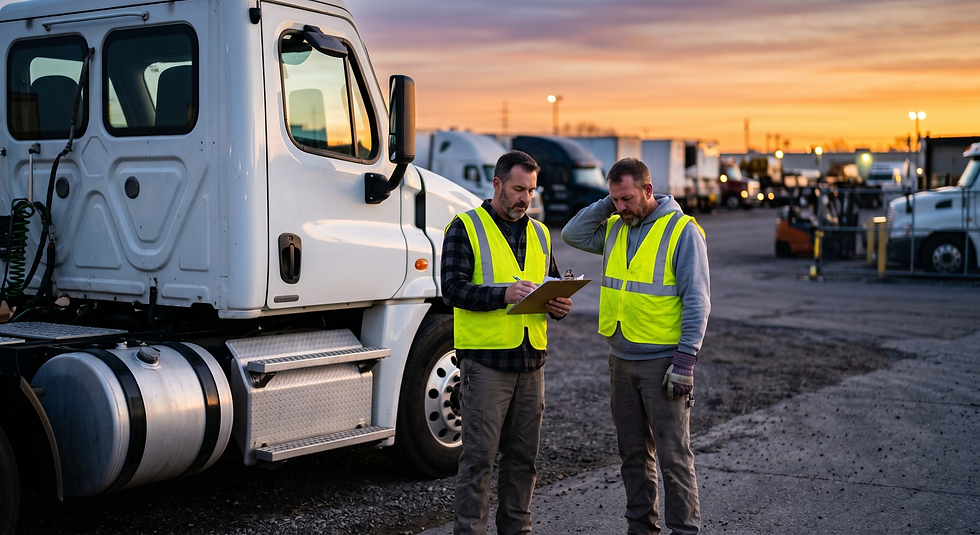
Here's what makes downtime so expensive: it never stays contained to the damaged vehicle. When one truck goes down, the work doesn't disappear. It gets redistributed, and that redistribution creates costs everywhere.
Route reassignment. When a garbage truck or delivery vehicle goes out of service, its route needs to be covered. Other trucks and drivers get pulled from their planned schedules to absorb the extra stops. Those trucks now run longer, burn more fuel, and put more wear on their vehicles.
Overtime pay. Drivers covering extra routes or extended shifts get paid overtime, typically 1.5x their normal rate. For a fleet where drivers earn $25 to $35 per hour, overtime adds up fast. One week of overtime for two drivers covering a downed truck's route can easily cost $2,000 to $4,000.
Replacement vehicle rental. If no spare truck is available, you may need to rent one. A comparable commercial vehicle rental can run $1,500 to $2,000+ per month for a cargo truck, and specialty vehicles like garbage trucks or cement mixers are even harder to source on short notice (Clean Fleet Report).
Accelerated wear on other vehicles. When remaining trucks absorb extra routes, they're being pushed harder than planned. That means more frequent maintenance, faster tire wear, and potentially shorter vehicle life, all of which add cost down the line.
The Admin Hours Nobody Tracks
After every accident, someone (usually several people) has to deal with the paperwork. This is time pulled directly from other productive work, and it adds up more than most companies realize.
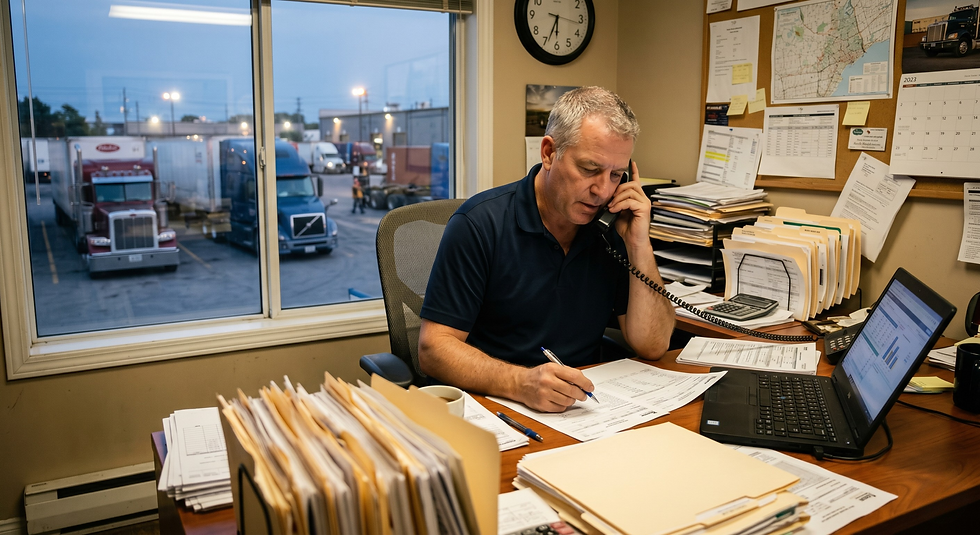
A single backing incident generates work across multiple departments: the driver files an incident report, a supervisor investigates the scene, the safety team reviews the event, operations reshuffles routes, and someone in admin processes the insurance claim. If the accident involves an injury or property damage to a third party, add legal coordination to the list.
Industry data suggests that administrative overhead from fleet accidents runs between 8% and 12% of the direct costs (Heavy Vehicle Inspection). But that only captures the measurable portion. The hours your operations manager spends on the phone with the body shop, the time your safety director uses to conduct an internal review, the back-and-forth with your insurance adjuster, none of that gets invoiced, but all of it pulls people away from their actual jobs.
For a single accident with $10,000 in direct costs, you're looking at $800 to $1,200 just in administrative overhead. For a fleet with 10 to 15 incidents per year, that's $8,000 to $18,000 annually in admin time that's essentially invisible on your balance sheet.
The Multiplier Effect: Indirect Costs vs. Direct Costs
Here's the stat that puts it all in perspective. According to OSHA, indirect costs (which include downtime, lost productivity, overtime, admin burden, and other hidden expenses) are typically 3 to 10 times higher than the direct costs of an accident (OSHA Safety Pays Program).
Read that again: 3 to 10 times.
So when a backing accident results in $5,000 in direct repair costs, the total financial impact on your operation could be anywhere from $15,000 to $50,000 when you account for all the indirect costs.
For a fleet experiencing multiple backing incidents per year, this multiplier turns what seems like a manageable problem into a serious drag on profitability.
Why Waste and Construction Fleets Get Hit Hardest
Downtime doesn't affect all fleets equally. Two industries feel it the most: waste management and construction.

Waste management fleets operate on fixed schedules with municipal contracts that often include penalties for missed pickups. When a garbage truck goes down, routes can't just wait. They need to be covered the same day, which means pulling resources from elsewhere and paying overtime to make it happen. And because garbage trucks are specialty vehicles, finding a short-term rental replacement isn't as simple as calling a truck rental company. These trucks also have some of the worst fuel economy of any commercial vehicle (around 2.5 MPG on average), so every extra mile driven by rerouted trucks costs more than it would in any other fleet type.
Construction fleets often operate with tight project timelines where a dump truck or cement mixer being out of service can delay an entire job site. A single day of project delay can cost a construction company thousands in penalties, idle crew wages, and equipment rental fees that keep running whether the project is moving or not.
In both industries, the trucks that reverse the most are the ones most likely to be involved in a backing incident, and most likely to be missed when they're out of service.
Adding It All Up
Let's use a real scenario. A 50-truck waste management fleet has a backing incident that keeps one truck out of service for two weeks.
Cost Category | Estimated Cost |
Vehicle downtime (10 business days x $760/day) | $7,600 |
Overtime for drivers covering extra routes | $3,000 |
Accelerated wear on other vehicles | $500 - $1,000 |
Administrative hours (investigation, claims, scheduling) | $1,000 - $1,500 |
Potential missed-pickup penalties (municipal contract) | $500 - $2,000 |
Total downtime and labour cost (one incident) | $12,600 - $15,100 |
And that's just the downtime and labour side. It doesn't include the repair bill, the insurance impact, or any legal costs if someone was injured. (We covered those in our companion article: How Much Does a Backing Accident Really Cost Your Fleet?)
Now multiply that by several incidents per year. For a fleet averaging 12 backing accidents annually, even if only a third of them result in significant downtime, you're looking at $50,000 to $60,000+ per year in downtime and labor losses alone.
Want to see the full picture for your fleet? Use our ROI Calculator to plug in your numbers and see what backing accidents are really costing you.
Prevention Is Cheaper Than Recovery
Every hour spent managing the aftermath of a backing accident is an hour that could have been spent on productive work. Every dollar spent on overtime, rentals, and admin is a dollar that didn't go toward growing the business.
The most effective way to eliminate these costs is to prevent the accident from happening in the first place.
Cameras and backup alarms help, but they rely on the driver to react. Given the realities of fatigue, distraction, and the massive blind spots on commercial trucks, reaction-based systems can only go so far.
Global Sensor Systems' automatic reverse braking technology takes a different approach. Sensors on the rear of the truck detect obstacles and automatically apply the brakes. No driver reaction needed. The truck stops itself.
It installs in under six hours, works on any air-brake commercial vehicle, and is a one-time purchase with no ongoing subscriptions. For a fleet spending tens of thousands annually on downtime from preventable backing incidents, the math is straightforward.
Three Things You Can Do Right Now
Start tracking the full cost. Most fleets track repair costs, but not the downtime, overtime, and admin hours that follow. Start measuring those, and you'll see the real number.
Calculate your exposure. Use our ROI Calculator to model your fleet's specific situation and see the annual savings from preventing backing accidents.
Talk to us. Get a quote and find out how automatic reverse braking fits into your fleet. We'll walk you through installation, training, and what to expect.
The accidents you prevent are always cheaper than the ones you manage.
Sources referenced in this article:
Fleet Maintenance / Element Fleet Management, The True Cost of Vehicle Downtime - fleetmaintenance.com
Track Your Truck, Ways to Avoid Fleet Downtime - trackyourtruck.com
Clean Fleet Report, One Crash Six Figures: What Fleet Accidents Actually Cost - cleanfleetreport.com
Heavy Vehicle Inspection, Fleet Repair Cost Management 2026 - heavyvehicleinspection.com
OSHA Safety Pays Program, Background of Cost Estimates - osha.gov


